Goethe Exam Guide (A1 to C2 Levels Explained) – Complete 2026 Guide
Published: 2026-05-04 04:58:24
Learning German opens doors to global careers, higher education in Germany, and exciting cultural experiences. If you’re planning to prove your German proficiency, the Goethe-Institut exams (A1–C2) are among the most recognized certifications worldwide. In this detailed guide, you’ll learn everything about Goethe exam levels, structure, scoring, and how to prepare effectively.
If you're planning to take a German certification, don’t miss our complete guide on German language proficiency exams to understand formats, levels, and preparation tips.
What is the Goethe Exam?
The Goethe-Institut Goethe-Zertifikat is one of the most trusted and globally recognized certifications for measuring your German language proficiency. It follows the Common European Framework of Reference for Languages (CEFR), ensuring your skills are evaluated at an international standard.
This exam is designed to test how effectively you can understand, communicate, and express yourself in real-life situations using German. It focuses on four essential language skills:
- Reading (Lesen): Understanding written texts like emails, articles, and notices
- Listening (Hören): Comprehending conversations, announcements, and audio clips
- Writing (Schreiben): Creating emails, letters, and structured responses
- Speaking (Sprechen): Communicating confidently in conversations and presentations
Why is the Goethe Exam Important?
The Goethe certificate is not just an exam it’s your gateway to global opportunities. It is widely accepted for:
- Germany Student Visas – Required proof of language proficiency
- Job Applications – Especially in MNCs and German companies
- Permanent Residency – Essential for long-term settlement
- University Admissions – Mandatory for many German-taught programs
Before applying, check out this detailed guide on Ausbildung in Germany to learn about requirements, age limits, and job opportunities.
Passing Criteria
- Minimum Passing Score: 60%
- Modular Flexibility: In many levels, you can pass each section (Reading, Listening, Writing, Speaking) individually
This flexible structure makes it easier for students to focus on improving specific skills without retaking the entire exam.
Goethe Exam Levels Explained (A1–C2)
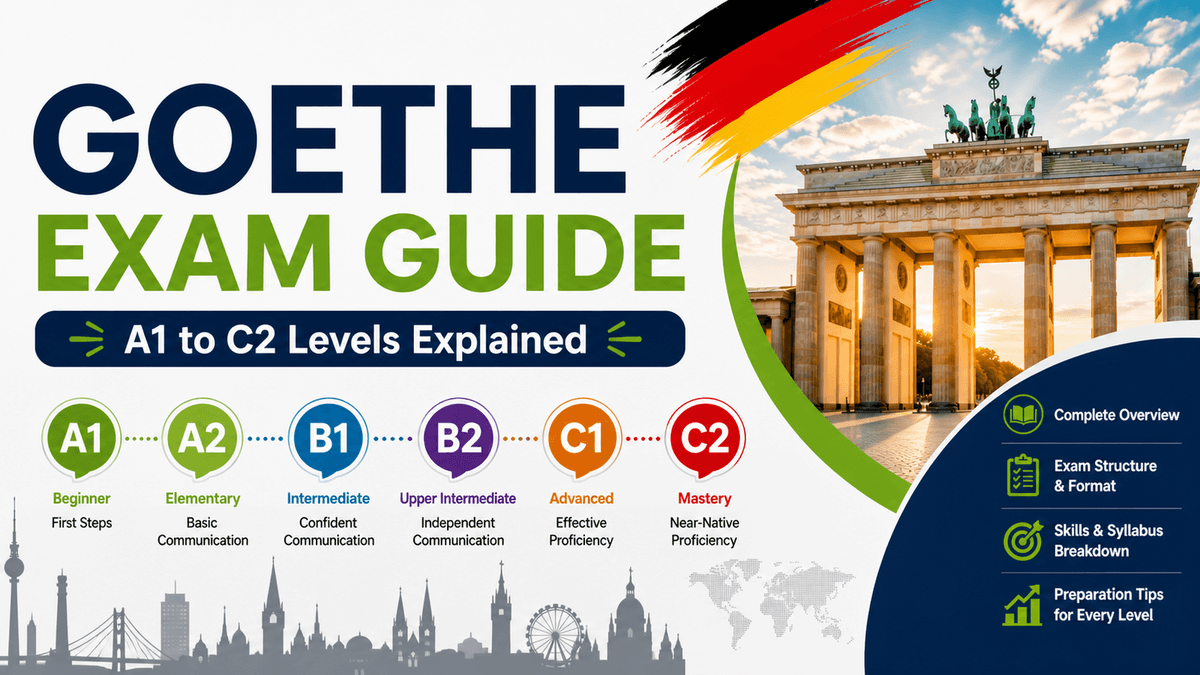
The Goethe exams are divided into six levels, ranging from beginner to mastery.
A1 Level – Beginner (Start Deutsch 1)
- Level: Basic knowledge
- Skills: Understand simple daily expressions and phrases
- Use Case: Spouse visa, family reunification
Exam Structure:
- Listening: Simple conversations
- Reading: Short texts, signs
- Writing: Emails or short notes
- Speaking: Basic introductions
👉 Perfect for absolute beginners starting their German journey.
Planning to study or work in Germany? Don’t miss our complete guide on German exam registration in India to understand dates, fees, and booking process.
A2 Level – Basic Knowledge
The A2 level is your next step after the basics, where you begin to communicate more confidently in everyday situations. At this stage, you move beyond simple phrases and start forming meaningful conversations.
- Level: Elementary communication
- Skills: Understand and use commonly used expressions related to daily life such as family, shopping, work, and travel
- Use Case:
- Entry-level job opportunities
- Basic visa requirements
- Daily communication in German-speaking environments
At the A2 level, you can handle real-life situations independently—like shopping in a market, asking for directions, booking tickets, or having simple conversations with locals.
B1 Level – Intermediate
The B1 level marks a major milestone in your German learning journey. At this stage, you become an independent user, capable of handling most real-life situations with confidence.
- Level: Independent user
- Skills: Communicate effectively in daily life, workplace, and academic environments
- Use Case:
- German citizenship applications
- Permanent residency (PR)
- Studienkolleg admission in Germany
At the B1 level, you can participate in conversations, express opinions, and manage everyday challenges without constant help.
Looking for budget-friendly language learning? Check out our guide on affordable online German courses to explore fees, benefits, and certification options.
B2 Level – Upper Intermediate
The B2 level is where your German skills become professionally valuable. At this stage, you can communicate clearly and confidently in both social and professional environments.
- Level: Advanced communication
- Skills: Understand complex texts, follow detailed discussions, and express ideas fluently on a wide range of topics
- Use Case:
- University admission in Germany
- Professional jobs (healthcare, IT, engineering, etc.)
At the B2 level, you can participate in meetings, write formal emails, and understand technical or academic content with ease.
C1 Level – Advanced
The C1 level represents a high degree of fluency, where you can communicate effortlessly and effectively in complex situations both academically and professionally.
- Level: Fluent and spontaneous communication
- Skills: Express ideas clearly, structure arguments logically, and understand advanced texts, discussions, and abstract concepts
- Use Case:
- Higher education (German-taught university programs)
- Specialized careers (research, management, consulting, etc.)
At the C1 level, you can participate in detailed discussions, give presentations, and write structured academic or professional content without difficulty.
Want to study from home with flexibility? Check out our complete guide on learn German language online course to understand structure, fees, and benefits.
C2 Level – Mastery (GDS)
The C2 level (Goethe-Zertifikat C2: GDS) is the highest level of German proficiency, representing near-native mastery of the language. At this stage, you can understand and use German with complete ease in any context, academic, professional, or social.
- Level: Near-native proficiency
- Skills: Effortlessly understand everything you hear or read, including complex texts, idioms, and nuanced expressions
- Use Case:
- Academic research and teaching roles
- High-level professional positions (management, law, academia, translation, etc.)
At the C2 level, you can analyze complex materials, engage in high-level debates, and communicate with precision and sophistication.
Starting your German journey from zero? Check out our complete guide on German A1 for absolute beginners to build a strong foundation in grammar and vocabulary.
Skills Tested in Goethe Exams
Every Goethe-Institut Goethe exam is designed to evaluate how well you can use German in real-life situations. To ensure a complete assessment, the exam focuses on four essential language skills:
Reading (Lesen)
Understand written content such as emails, advertisements, articles, and official notices.
Tests your ability to grasp meaning, identify key information, and interpret context.
Listening (Hören)
Comprehend spoken German through conversations, announcements, interviews, and audio clips.
Helps evaluate how well you follow real-life conversations and spoken instructions.
Writing (Schreiben)
Create structured written responses like emails, essays, and formal letters.
Measures your ability to express ideas clearly, logically, and correctly in written German.
Speaking (Sprechen)
Participate in conversations, introduce yourself, and present opinions or ideas.
Tests your confidence, fluency, pronunciation, and communication skills.
Planning to study in Germany? Don’t miss our complete guide on TestDaF exam eligibility and registration in India to understand requirements, dates, and booking steps.
Goethe Exam Scoring System
The Goethe-Institut Goethe exam uses a clear and student-friendly scoring system designed to evaluate your overall language proficiency.
- Total Marks: 100
- Passing Marks: Minimum 60% required to pass
- Modular System: Available in many levels (especially B1–C2)
Each section Reading, Listening, Writing, and Speaking is assessed separately, giving you a detailed understanding of your strengths and areas for improvement.
What Makes It Student-Friendly?
One of the biggest advantages of the Goethe exam is its flexibility:
- You can retake individual modules instead of the full exam
- Focus only on the section you need to improve
- Saves time, effort, and exam fees
If you want to learn German without spending money, explore our complete guide on best free resources to learn German for top apps, websites, and study tools.
Why Goethe Certification is Important?
The Goethe-Institut Goethe-Zertifikat is more than just a language certificate; it is a globally respected proof of your German proficiency that opens doors to international opportunities.
- Globally recognized: Accepted by universities, employers, and government institutions worldwide
- Essential for Germany visas: Required for student visas, job visas, and family reunification
- Enhances career opportunities: Increases your chances of working with MNCs and German companies
- Supports university admissions: Mandatory for many German-taught programs
- Strengthens your resume: Demonstrates verified language skills and commitment
In today’s competitive environment, having a Goethe certification gives you a clear advantage when applying for jobs, higher education, or relocation to Germany.
Confused about which German exam to choose? Read our detailed comparison on Goethe vs TestDaF vs Telc German exam 2026 to find the best option for your goals.
How to Prepare for Goethe Exams (Pro Tips)
Preparing for the Goethe exam requires consistency, strategy, and the right resources. Here are some proven tips to help you succeed:
- Follow a structured study plan: Break your preparation into daily and weekly goals based on your target level
- Practice mock tests regularly: Familiarize yourself with the exam format and improve time management
- Focus on speaking practice: Engage in conversations, group discussions, and presentations to build confidence
- Improve vocabulary daily: Learn and revise new words, phrases, and sentence structures consistently
- Use multimedia resources: Watch German movies, listen to podcasts, and read articles to enhance comprehension
A balanced approach that focuses on all four skills reading, listening, writing, and speaking—will significantly improve your chances of achieving a high score.
Learn German with TILS – School of Foreign Languages
If you’re serious about clearing the Goethe-Institut Goethe exams, choosing the right training institute can make a significant difference in your results.
At TILS – School of Foreign Languages, the focus is on building strong language fundamentals along with exam-oriented preparation, so you don’t just learn German you clear your certification with confidence.
What TILS Offers:
- Expert trainers with advanced fluency: Learn from experienced faculty who understand both the language and exam patterns
- Structured A1–C2 curriculum: Step-by-step learning aligned with international standards
- Real exam-based practice: Regular mock tests and practice sessions based on actual Goethe exam formats
- Flexible learning options: Choose between online and offline classes based on your schedule
- Complete exam & visa guidance: End-to-end support for Goethe exams, Germany study plans, and visa processes
With the right mentorship and a proven training approach, TILS helps you move from beginner to advanced levels with clarity and confidence.
Start Your German Journey Today
Visit Us
2/81-82, 2nd Floor, Lalita Park, Laxmi Nagar, New Delhi - 110092
Email Us
info@teamforeignlanguages.com
Take the first step toward your global career with professional German language training
Enroll Today – Start Your German Journey!
Don’t wait to build your global career!
Visit Us
2/81-82, 2nd Floor, Lalita Park, Laxmi Nagar, New Delhi - 110092
Call Us
91 9218071730
Email Us
info@teamforeignlanguages.com
Book your FREE demo class today and start learning German with experts!
FAQs – Goethe Exam Guide
Q1. What is the minimum passing score?
The Goethe-Institut Goethe exam requires a minimum of 60% overall to pass. Each module—Reading, Listening, Writing, and Speaking—is evaluated separately, and in many cases, you can retake only the module you didn’t clear.
Q2. Which level is required for a Germany student visa?
Most German universities require B1 or B2 level, depending on the course and medium of instruction. For English-taught programs, A2 or B1 may sometimes be sufficient, but having B2 significantly improves your chances of admission and visa approval.
Q3. Can I take the Goethe exam online?
Some Goethe exams are available in digital format at authorized centers, but fully remote (from-home) options are limited. In most cases, you will need to appear at an official exam center for identity verification and standardized testing.
Q4. How long does it take to reach B2 level?
With consistent study and proper guidance, it typically takes 6–9 months to reach B2 from beginner level. However, the timeline can vary based on your learning pace, study hours, and practice consistency.
Q5. Is the Goethe certificate valid for a lifetime?
Yes, the Goethe certificate does not expire. It remains valid indefinitely as proof of your German language proficiency. However, some universities or employers may prefer a recently obtained certificate (usually within the last 2–3 years).
Q6. How can I register for the Goethe exam?
You can register through the official Goethe-Institut website or visit a certified exam center. It is recommended to book your slot early, as exam dates fill up quickly, especially for B1 and B2 levels.
Q7. What documents are required for the exam?
You generally need a valid passport or government-issued ID for registration and on the exam day. Always check specific requirements with your chosen test center.
Q8. Can I skip levels and directly take a higher-level exam?
Yes, you can directly attempt any level (e.g., B2 or C1) without clearing previous levels. However, you should ensure your skills match that level, as the difficulty increases significantly.
Q9. Which Goethe level is best for jobs in Germany?
For most professional roles, B2 or C1 level is preferred. Jobs in healthcare, engineering, and customer-facing roles often require strong communication skills, making higher-level certification essential.
Q10. What happens if I fail the Goethe exam?
If you do not pass, you can retake the exam or specific modules. There is no limit on the number of attempts, allowing you to improve and try again with better preparation.
Q11. Is coaching necessary to pass the Goethe exam?
While self-study is possible, enrolling in a professional institute like TILS – School of Foreign Languages can significantly improve your chances through structured learning, expert guidance, and exam-focused practice.
Q12. How often are Goethe exams conducted?
Goethe exams are conducted multiple times a year, depending on the level and location. Major cities usually have more frequent exam dates compared to smaller centers.
Final Thoughts
The Goethe-Zertifikat is your gateway to studying, working, and settling in Germany. Whether you’re starting from A1 or aiming for C2 mastery, the right guidance and preparation can make all the difference.
Start today with TILS – School of Foreign Languages and turn your German dream into reality!