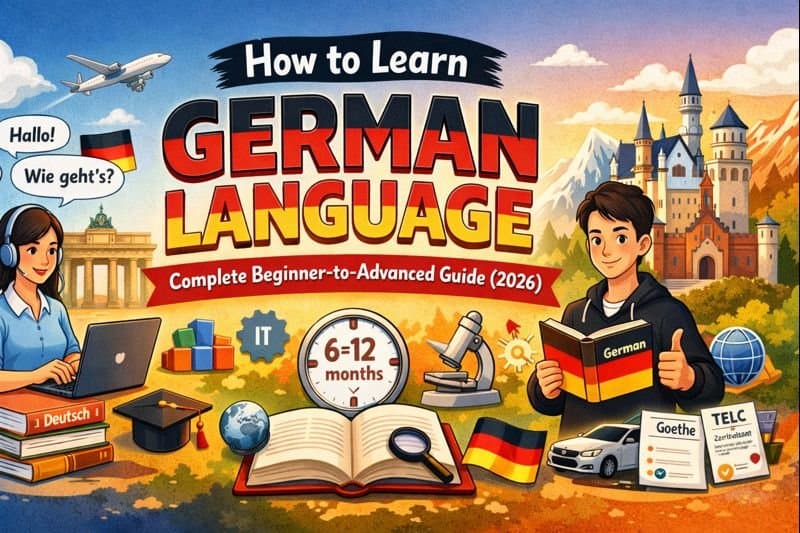
How to Learn German Language: Complete Beginner-to-Advanced Guide (2026)
Published: 2026-01-21 05:49:22
Learning the German language has become one of the smartest decisions for students, professionals, and migration aspirants in India. Whether your goal is studying in Germany, working with German companies, or simply mastering a powerful European language, German opens doors globally.
This guide answers every major question people search online from how to learn German at home for free, is German easy or hard, how much time it takes, to certification, levels, and daily-use sentences.
Explore options in High Paying Foreign Languages.
What Is the German Language?
The German language (Deutsch) is a West Germanic language and shares strong linguistic roots with English and Dutch, which is why many German words and sentence structures feel surprisingly familiar to English speakers. It is the most widely spoken native language in Europe, making it one of the most influential languages on the continent.
German is the official language of Germany and Austria, and it is also widely spoken in Switzerland, Luxembourg, and parts of Belgium and Italy. Beyond Europe, German is recognized globally as a language of innovation, precision, and academic excellence.
Today, learning German is no longer just about communication it’s a powerful career skill. Germany is Europe’s strongest economy and home to some of the world’s leading companies and research institutions. As a result, German language proficiency is highly valued in fields such as:
- Engineering – mechanical, automotive, and industrial sectors
- IT & Software – development, data, AI, and enterprise systems
- Automotive – global brands and advanced manufacturing
- Healthcare – nursing, medical research, and allied health roles
- Research & Academia – universities, scholarships, and innovation hubs
In short, German is not just a language you learn it’s a gateway to global education, high-paying careers, and international opportunities.
German aspirants can check German Language Course Fees in Delhi
Where Is German Language Spoken?
The German language is spoken across multiple countries in Europe, making it one of the most important and widely used languages in the region. It is the official or co-official language in more than six countries, giving German a strong international presence.
German is spoken in:
- Germany – the heart of the German language and Europe’s largest economy
- Austria – where German is the national language
- Switzerland – one of the four official languages, widely used in daily life and business
- Luxembourg – an official administrative and spoken language
- Liechtenstein – the sole official language of the country
- Parts of Belgium and Italy – especially in regions near the German-speaking borders
Beyond Europe, German is spoken by over 130 million people worldwide as either a native or second language. Strong German-speaking communities also exist in countries like the USA, Canada, and Australia, driven by migration, education, and global business ties.
Because German is used across education, industry, and international trade, learning it gives you the ability to communicate, work, and study across borders, not just in one country but throughout the German-speaking world.
If you’re looking for quality training, check out the German Language Classes in Delhi guide for tips on choosing the right program.
https://www.teamforeignlanguages.com/blogs/german-language-classes-in-delhi
Is German Language Easy or Hard to Learn?
One of the most commonly searched questions by beginners is: “Is German a hard language to learn?”
The honest answer is German is moderately difficult, but highly logical.
Unlike many languages that rely heavily on memorization, German follows clear rules and structured patterns, which actually makes it easier to understand once the basics are in place.
Why German Feels Easy for Many Learners
- Same alphabet as English, so there’s no need to learn a new script
- Many familiar words due to shared roots with English
(Haus – House, Wasser – Water, Hand – Hand) - Logical grammar rules that, once learned, apply consistently
Why Some Learners Find German Challenging
- Grammatical genders (der, die, das) can feel confusing at first
- Sentence structure, especially verb placement, takes practice
- Long compound words, which look intimidating but are actually combinations of smaller, simple words
The key thing to remember is this: German rewards structure and practice. Once you understand why a rule exists, the language starts to make sense quickly.
With the right guidance, regular speaking practice, and a clear learning path, German is far easier than most people expect—and often easier than French for English speakers.
If you’re exploring local options, check out the Top German Language Course Near Me guide to find the best classes nearby.
https://www.teamforeignlanguages.com/blogs/top-german-language-course-near-me
How Many Levels Are There in German Language?
The German language follows the internationally recognized CEFR framework (Common European Framework of Reference for Languages). This system divides German proficiency into six clearly defined levels, making it easy to track your progress from beginner to near-native fluency.
Here’s a simple breakdown of the German language levels:
| Level | Name | What You Can Do |
| A1 | Beginner | Use basic words, introduce yourself, form simple sentences |
| A2 | Elementary | Handle daily conversations, shopping, travel, and routine tasks |
| B1 | Intermediate | Communicate independently for work, studies, and daily life |
| B2 | Upper-Intermediate | Speak confidently in professional and workplace settings |
| C1 | Advanced | Use German fluently for academics, research, and corporate roles |
| C2 | Mastery | Understand and speak German almost like a native speaker |
For most learners, reaching B1 or B2 level is the sweet spot. These levels are widely accepted for Germany study visas, job opportunities, and professional careers. At B1, you can live independently in a German-speaking country, while B2 allows you to work confidently in corporate and technical environments.
The best part? You don’t need to master all six levels to succeed. With focused learning and consistent practice, B1 or B2 is achievable within a year and it’s enough to unlock life-changing opportunities in Germany and beyond.
Explore all programs on our Courses Page.
If you’re searching for quality language training, explore the Best German Language Institute in Laxmi Nagar for top options and tips.
https://www.teamforeignlanguages.com/blogs/best-german-language-institute-in-laxmi-nagar
How Long Does It Take to Learn German Language?
Another top question: “How much time does it take to learn German?”
Average timeline:
- A1: 2–3 months
- A2: 3–4 months
- B1: 6–8 months
- B2: 10–12 months
With structured classes daily practice, German can be learned faster than French for English speakers.
How to Start Learning German Language (Beginner Roadmap)
Starting German can feel overwhelming, but with the right step-by-step approach, it becomes simple and enjoyable. Here’s a short, beginner-friendly roadmap to get you started confidently:
Step 1: Learn German Alphabets & Sounds
German uses the same alphabet as English, with four extra letters: ä, ö, ü, ß. Focus on correct pronunciation from day one—it makes speaking much easier later.
Step 2: Practice Daily Common Sentences
Begin with everyday phrases you can use immediately:
- Hello → Hallo
- How are you? → Wie geht es Ihnen?
- Thank you → Danke
- Please → Bitte
- No → Nein
- Good night → Gute Nacht
Step 3: Understand Grammar Basics
Learn the foundation rules:
- Articles (der / die / das)
- Verb placement in sentences
- Simple sentence formation
Don’t aim for perfection—aim for understanding.
Step 4: Speak Every Day
Speaking is non-negotiable. Even 10–15 minutes daily talking to yourself or a partner builds confidence and fluency faster than memorizing rules.
👉 Follow this roadmap consistently, and German will start feeling natural, structured, and surprisingly easy within weeks.
Explore all programs on our Courses Page.
Before you enroll in German classes, check the German Language Course Fees guide to understand the pricing structure and options.
https://www.teamforeignlanguages.com/blogs/german-language-course-fees
How to Learn German Language at Home for Free
Many learners ask: “How to learn German at home for free?”
Free resources:
- YouTube German channels
- Language apps (Duolingo, DW Learn German)
- Free PDFs & grammar guides
Limitation:
Free learning often lacks:
- Speaking correction
- Certification
- Structured progression
👉 Best approach: Combine free tools with expert guidance.
How to Learn German Language in India (Best Method)
If you’re in India, structured learning gives faster & certified results.
Why classroom or live online learning works better:
- Trained trainers
- Exam-oriented preparation
- Speaking confidence
- Visa-ready certification
This is where TILS – School of Foreign Languages stands out.
Apply directly through Admission Page.
Looking for guidance? Visit our homepage: Team Foreign Languages.
If you’re looking for nearby German training options, check out German Language Classes Near Me for helpful guidance and tips.
https://www.teamforeignlanguages.com/blogs/german-language-classes-near-me
Why Choose TILS – School of Foreign Languages?
TILS is one of India’s most trusted institutes for German language training, guiding learners from A1 (Beginner) to C1 (Advanced) with a practical, results-driven approach.
What Makes TILS Stand Out?
- Certified, native-level trainers with real teaching expertise
- Small batch sizes for personal attention
- Speaking-first methodology to build real confidence
- Exam-focused preparation (Goethe & TELC style)
- Flexible learning with both Online & Offline classes
Who Is It Perfect For?
- Students planning higher education in Germany
- Professionals targeting German-speaking jobs and MNCs
- Absolute beginners with zero prior knowledge
👉 If you want structured learning, faster progress, and real fluency, TILS gives you the right guidance from day one.
If you’re planning to take a certification test, check out German Language Exam Fees in India to understand the costs involved.
https://www.teamforeignlanguages.com/blogs/german-language-exam-fees-in-india
How to Get German Language Certificate?
To officially prove your German skills, you need certification.
Popular German language certificates:
- Goethe-Zertifikat
- TELC
- ÖSD
Most universities and employers accept B1 or B2 level certification.
👉 TILS provides complete exam preparation support.
Apply directly through Admission Page.
Looking for guidance? Visit our homepage: Team Foreign Languages.
German vs French: Which Language Is Easier?
This is highly searched: Which language is easy—French or German?
| Factor | German | French |
| Pronunciation | Easier | Difficult |
| Grammar | Logical | Complex |
| Sentence structure | Fixed rules | Flexible |
| For English speakers | Easier | Moderate |
👉 German is often easier for Indians & English speakers.
Is German Worth Learning in 2026?
Absolutely ✔️
Career benefits:
- High-paying jobs in Germany
- Global MNC opportunities
- PR & migration benefits
- Free or low-cost education in Germany
German speakers are highly paid & less competitive compared to English-only candidates.
Apply directly through Admission Page.
Looking for guidance? Visit our homepage: Team Foreign Languages.
Daily-Use German Sentences (Most Searched)
- What is your name? → Wie heißen Sie?
- Where are you from? → Woher kommen Sie?
- How old are you? → Wie alt sind Sie?
- Do you speak English? → Sprechen Sie Englisch?
- Have a good day → Einen schönen Tag noch
How to Speak German Fluently (Pro Tips)
- Speak daily (even alone)
- Watch German movies with subtitles
- Think in German, not translate
- Join speaking-focused classes
Fluency depends more on speaking practice than grammar memorization.
Visit & Contact – TILS School of Foreign Languages
📍 Visit Us:
2/81-82, Ground Floor,
Lalita Park, Laxmi Nagar,
New Delhi – 110092
📞 Call Us:
91 9218071730
📧 Email Us:
info@teamforeignlanguages.com
Frequently Asked Questions (FAQs)
Q1. Is the German language easy for beginners?
Yes. German is beginner-friendly, especially for English speakers. Since it uses the same alphabet and follows logical grammar rules, beginners can comfortably reach A1 level within 2–3 months with structured learning and regular practice.
Q2. How many months does it take to learn German fluently?
It depends on your goal. For basic communication (A2), it may take 4–5 months. For professional-level fluency (B1–B2), most learners need 6–12 months with consistent speaking practice.
Q3. Is German compulsory to study in Germany?
For many English-taught programs, German is not compulsory. However, for part-time work, internships, full-time jobs, and daily life, knowing German is extremely important and often required.
Q4. Can I learn German online in India?
Absolutely. Live online German classes with certified trainers, interactive sessions, and speaking practice are highly effective and produce results similar to classroom learning.
Q5. Is German better than French for career opportunities?
Yes, especially in engineering, IT, healthcare, research, and manufacturing. German-speaking professionals are in high demand across Europe, and competition is often lower compared to French.
Q6. Which German level is required for jobs in Germany?
Most employers require at least B1, while B2 is preferred for professional and technical roles. Healthcare and corporate jobs often ask for B2 level.
Q7. How many hours should I study German daily?
Studying 60–90 minutes per day is ideal. This should include vocabulary, grammar, listening, and speaking practice, which is the most important part.
Q8. Can I learn German if I have no language background?
Yes. German is suitable for absolute beginners. With proper guidance, even students with no prior foreign-language experience can progress smoothly.
Q9. Is German useful outside Germany?
Definitely. German is spoken in multiple European countries and valued globally by multinational companies, universities, and research institutions.
Q10. Is learning German worth it in 2026 and beyond?
100% yes. German offers high-paying jobs, education opportunities, PR pathways, and global mobility, making it one of the most valuable languages to learn today.
👉 If you’re serious about learning German, choosing the right institute and learning method can cut your learning time in half and help you achieve real fluency faster.
Final Words
If you’re serious about learning German language, don’t rely only on random resources. A structured approach, expert guidance, and consistent speaking practice make all the difference.
Whether you are a student, working professional, or migration aspirant, German can be your career multiplier in 2026.
Start your German journey today with TILS – School of Foreign Languages and move confidently toward global opportunities.