Understanding ÖSD German Exam Levels
Published: 2026-07-30 11:48:57
Planning to prove your German language skills for study, work, or immigration purposes? The ÖSD (Österreichisches Sprachdiplom Deutsch) exam is one of the most trusted and internationally recognized German language certifications available today. Whether you're a complete beginner or an advanced speaker aiming for near-native fluency, understanding the ÖSD German exam levels is the first step toward choosing the right certificate for your goals.
In this guide, we'll break down everything you need to know from what the ÖSD is, to how its levels align with the CEFR framework, to how you can pick the exam level that's right for you. And if you're in Delhi and looking for expert, structured guidance to prepare for your ÖSD exam, TILS – School of Foreign Languages is here to help you every step of the way.
Learn about the ÖSD German Exam and its levels, eligibility, and preparation requirements.
What is the ÖSD?
The ÖSD, short for Österreichisches Sprachdiplom Deutsch (Austrian Language Diploma German), is an internationally recognized certification system for German as a foreign language (Deutsch als Fremdsprache). Unlike exams tied to a single country's German variant, the ÖSD is unique because it tests pluricentric German — meaning it accounts for the vocabulary, pronunciation, and cultural nuances of German as spoken in Germany, Austria, and Switzerland.
This makes the ÖSD certificate especially valuable for people planning to live, study, or work in any German-speaking country, since it doesn't favor one national variety of German over another. Universities, employers, immigration authorities, and language institutes across the globe recognize ÖSD certificates as valid proof of German language proficiency, making it a smart choice for learners with international ambitions.
Want to start learning German? Read our guide on how to learn German language from scratch.
Overview of Exam Levels: A1 to C2
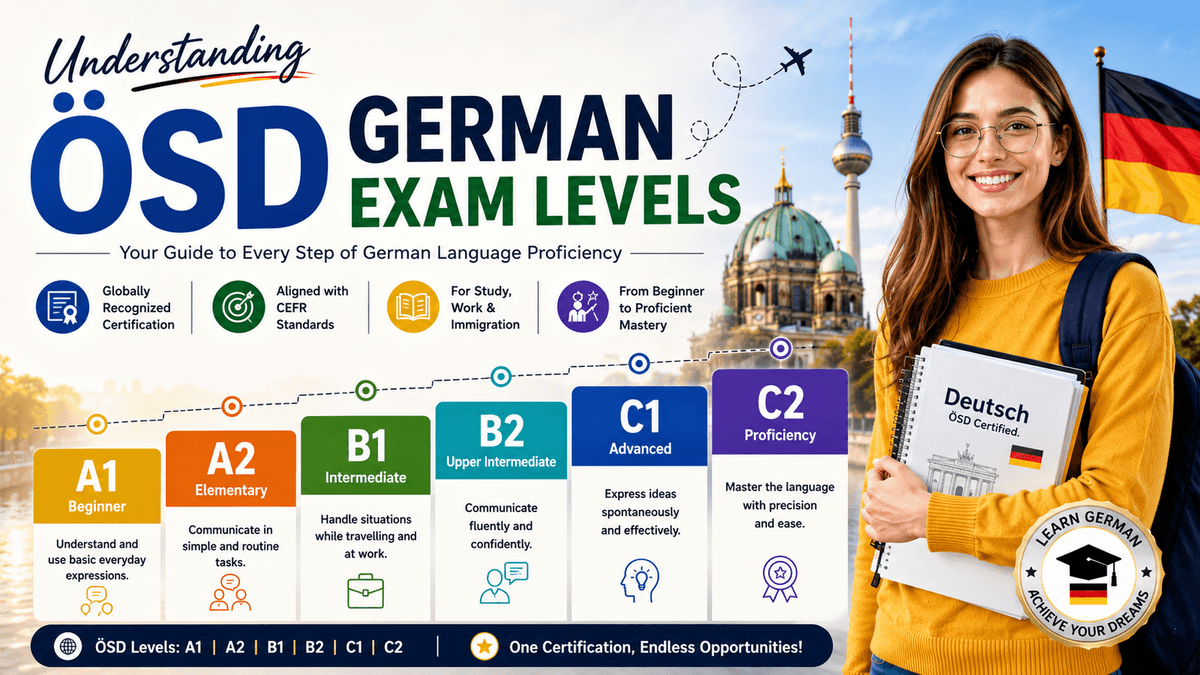
The ÖSD certification system spans six proficiency levels, catering to adults, teenagers, and children. Here's a detailed breakdown:
Elementary Use of Language (A1 and A2)
- ÖSD Zertifikat A1: Designed for absolute beginners who need to communicate in familiar, everyday situations using simple sentences and basic vocabulary. This level is available as A1 (for adults) and KID A1 (for children aged 10–14), making it a great starting point for young learners as well.
- ÖSD Zertifikat A2: Suited for learners who can understand frequently used expressions and exchange information on routine, familiar tasks. Like A1, this level is available as A2 (for adults) and KID A2 (for children aged 10–14).
Independent Use of Language (B1 and B2)
- ÖSD Zertifikat B1: Ideal for intermediate learners who can handle most travel situations, discuss familiar topics with confidence, and give brief reasons or explanations for their opinions and plans. This level is available for both adults and teenagers (B1 / Jugendliche).
- ÖSD Zertifikat B2: Demonstrates a clear command of complex texts and the ability to discuss both concrete and abstract topics fluently. B2 is often the standard entry-level certificate required for professional environments, job applications, and many university study programs in German-speaking countries.
Looking for free study materials? Check our guide to the best free resources to learn German.
Proficient Use of Language (C1 and C2)
- ÖSD Zertifikat C1: Designed for advanced learners who can understand a wide range of demanding, longer texts and use the language flexibly and effectively for social, academic, and professional purposes.
- ÖSD Zertifikat C2: The highest level in the ÖSD system, proving near-native competency. Candidates at this level can understand, summarize, and express subtle nuances of meaning spontaneously and with ease — a benchmark of true language mastery.
How ÖSD Levels Correspond to CEFR Standards
All ÖSD exam levels are strictly aligned with the Common European Framework of Reference for Languages (CEFR) — the internationally accepted standard for describing language ability. This alignment ensures that an ÖSD B2 certificate, for example, is universally understood to represent the same proficiency benchmark as a B2-level certificate from any other recognized European language testing body.
| CEFR Level | ÖSD Certificate | Proficiency Description |
| A1 | ÖSD Zertifikat A1 / KID A1 | Basic, everyday communication |
| A2 | ÖSD Zertifikat A2 / KID A2 | Simple, routine information exchange |
| B1 | ÖSD Zertifikat B1 / Jugendliche | Independent handling of familiar situations |
| B2 | ÖSD Zertifikat B2 | Fluent, professional-level communication |
| C1 | ÖSD Zertifikat C1 | Advanced, flexible language use |
| C2 | ÖSD Zertifikat C2 | Near-native mastery |
Exam Formats & Dictionary Rules
The structure of the exam modules and dictionary allowances vary by level:
| CEFR Level | Structure Type | Dictionary Allowance |
| A1 | 2 Modules (Written & Oral) | No dictionaries allowed |
| A2 | 2 Modules (Written & Oral) | No dictionaries allowed |
| B1 | 4 Independent Modules (Reading, Listening, Writing, Speaking) | No dictionaries allowed |
| B2 | 2 Modules (Written & Oral) | Monolingual or Bilingual dictionaries allowed |
| C1 | 2 Modules (Written & Oral) | Monolingual dictionaries only (German-German) |
| C2 | 4 Independent Modules | Monolingual dictionaries only (German-German) |
Important Note: For exams with 2 modules, if you fail a section of the written exam, you must retake the entire written module (Reading, Listening, and Writing combined). For 4-module exams, you can retake each module completely on its own, offering more flexibility for candidates who only need to improve one skill area.
Find the right course with our guide to affordable German language classes in Delhi NCR.
Importance of Understanding Your Language Proficiency Level
Knowing exactly where you stand on the CEFR scale isn't just a formality — it has real, practical consequences for your academic, professional, and immigration journeys. Here's why understanding your ÖSD level matters:
- University Admissions: Many German and Austrian universities require a minimum of B2 or C1 level German for admission into degree programs, especially for courses taught in German.
- Job Applications: Employers in German-speaking countries often specify a required CEFR level in job postings. Presenting the wrong certificate — or none at all — can cost you an opportunity.
- Visa and Immigration Requirements: Countries like Germany and Austria often require proof of language proficiency (commonly A1, A2, or B1) for family reunification visas, work visas, or citizenship applications.
- Avoiding Wasted Time and Money: Registering for an exam level that's too advanced (or too basic) for your current ability can lead to failed attempts, wasted exam fees, and unnecessary frustration.
- Structured Learning Path: Understanding CEFR levels helps you and your language instructor design a realistic study plan, track your progress accurately, and set achievable milestones.
Simply put, your ÖSD certificate is often the single document standing between you and your goals abroad so getting the level right matters.
Confused between German exams? Compare Goethe vs TestDaF vs telc German exams to choose the right certification.
How to Choose the Right ÖSD Exam Level for You
Choosing the correct ÖSD exam level depends on several personal factors. Here's a simple framework to help you decide:
1. Define Your Purpose
- Immigration/Visa purposes: Usually A1–B1 is required, depending on the visa category (e.g., spouse visa often needs A1, while some work visas may need B1 or higher).
- University Study: B2 or C1 is typically required for German-taught bachelor's or master's programs.
- Professional/Job Purposes: B2 or C1 is generally expected for skilled professional roles.
- Personal Fluency Goals: If you simply want to achieve fluency, working progressively from A1 to C2 is ideal.
2. Assess Your Current Ability
If you're unsure of your current level, taking a placement test or diagnostic assessment (offered by most language schools, including TILS) can help identify your starting point accurately before you commit to an exam level.
3. Consider the Exam Format
If you're someone who prefers the flexibility to retake only a specific failed section, levels with 4 independent modules (B1 and C2) may suit you better than the 2-module formats where a single failure means retaking the whole written exam.
4. Factor in Age-Specific Options
If you're preparing your child for early language certification, the KID A1 and KID A2 levels (ages 10–14) and the B1/Jugendliche option for teenagers are specifically designed with age-appropriate content and difficulty.
5. Get Expert Guidance
The safest way to choose the right level is to consult with experienced language trainers who can assess your current proficiency and recommend a level aligned with your specific goals — whether that's a visa application, a university application, or a career move.
Learn German from home with our guide to the online German language course in Delhi.
Why Choose TILS – School of Foreign Languages?
Passing the ÖSD German Exam requires more than just learning vocabulary—it demands the right strategy, expert guidance, and consistent practice. At TILS – School of Foreign Languages, we provide comprehensive ÖSD exam preparation designed to help you succeed with confidence at every CEFR level, from A1 to C2.
Whether you're preparing for higher education, career opportunities, visa applications, or immigration, our experienced German language trainers ensure you're fully prepared for every section of the exam.
Why Students Choose TILS
Expert coaching for ÖSD German Exam Levels A1, A2, B1, B2, C1, and C2
Dedicated batches for adults, teenagers, and children (ÖSD KID A1 & A2)
CEFR-aligned curriculum with the latest ÖSD exam pattern
Regular mock tests based on the actual ÖSD examination format
Personalized feedback to improve Reading, Listening, Writing, and Speaking skills
Flexible weekday and weekend batches for students and working professionals
Small batch sizes with individual attention from certified trainers
Guidance for student visas, work visas, immigration, university admissions, and career opportunities in Germany and Austria
Our structured learning approach focuses on building strong language skills while preparing you for the real exam environment. From mastering grammar and vocabulary to developing confidence in speaking and writing, we help you achieve your target score with practical training and expert mentorship.
Discover what to look for when selecting the best German language course in Delhi.
Start Your ÖSD German Language Journey Today!
Whether you're aiming for an ÖSD A1 certificate for visa purposes or working toward an ÖSD C2 certification for academic or professional excellence, TILS – School of Foreign Languages is here to support your success at every step.
Join one of Delhi's trusted German language institutes and prepare for the ÖSD exam with confidence.
Frequently Asked Questions (FAQs)
Q1. What does ÖSD stand for?
ÖSD stands for Österreichisches Sprachdiplom Deutsch, which translates to the Austrian Language Diploma for German — an internationally recognized German language proficiency certification.
Q2. Is the ÖSD certificate valid in Germany, Austria, and Switzerland?
Yes. The ÖSD tests pluricentric German, meaning it's recognized and accepted across all German-speaking countries, not just Austria.
Q3. Which ÖSD level do I need for a German visa?
This depends on the type of visa. Family reunification visas often require A1, while some work or long-term visas may require A2 or B1. Always check the specific requirement with the relevant embassy or consulate.
Q4. What ÖSD level is required for university admission in Germany or Austria?
Most universities require at least a B2 level, though some programs may ask for C1, especially for German-taught courses.
Q5. Can children take the ÖSD exam?
Yes, children aged 10–14 can take the KID A1 and KID A2 levels, which are specially designed with age-appropriate content.
Q6. What happens if I fail a section of the ÖSD written exam?
For 2-module exams (A1, A2, B2, C1), failing any part of the written module means you must retake the entire written module. For 4-module exams (B1 and C2), you only need to retake the specific module you failed.
Q7. Are dictionaries allowed during the ÖSD exam?
It depends on the level. A1, A2, and B1 do not allow dictionaries. B2 allows monolingual or bilingual dictionaries, while C1 and C2 only allow monolingual (German-German) dictionaries.
Q8. How can I find out my current German proficiency level?
You can take a placement or diagnostic test at a language institute like TILS – School of Foreign Languages to accurately determine your current level before enrolling in an exam preparation course.
Q9. How long does it take to prepare for an ÖSD exam?
Preparation time varies based on your starting level and target certificate — ranging from a few weeks for A1 to several months for C1/C2, depending on your existing German proficiency and study intensity.
Q10. Where can I get professional ÖSD exam coaching in Delhi?
TILS – School of Foreign Languages offers structured, expert-led ÖSD exam preparation courses for all levels (A1 to C2) in Delhi, with batches for adults, teenagers, and children.
Get in Touch with TILS – School of Foreign Languages
Take the first step toward achieving your German language certification goals. Our expert trainers are ready to guide you through every ÖSD exam level, from A1 to C2.
📍 Visit Us 2/81-82, 2nd Floor, Lalita Park, Laxmi Nagar, New Delhi - 110092
📧 Email Us info@teamforeignlanguages.com