How to Introduce Yourself in German: A Complete Beginner's Guide (A1/A2)
Published: 2026-02-24 05:42:23
Learning how to introduce yourself in German is the very first step in your German-speaking journey. Whether you are preparing for a German language exam, attending a job interview, traveling to Germany or Austria, studying at a German university, or simply meeting new people, a confident self-introduction opens every door.
For A1 and A2 level learners, self-introduction is not just a lesson it is a survival skill. The moment you say "Hallo, ich heiße..." (Hello, my name is...), you break the language barrier and start building real connections. German-speaking countries value directness and clarity, so knowing how to introduce yourself properly both formally and informally gives you an immediate cultural and professional advantage.
This guide covers everything: basic sentences, full introduction paragraphs, formal and informal styles, interview-specific language, common mistakes, vocabulary tables, and FAQs. Let's begin.
Learn more German basics with our comprehensive course at Team Foreign Languages German course — https://www.teamforeignlanguages.com/courses/german
How to Introduce Yourself in German
To introduce yourself in German, use this basic format:
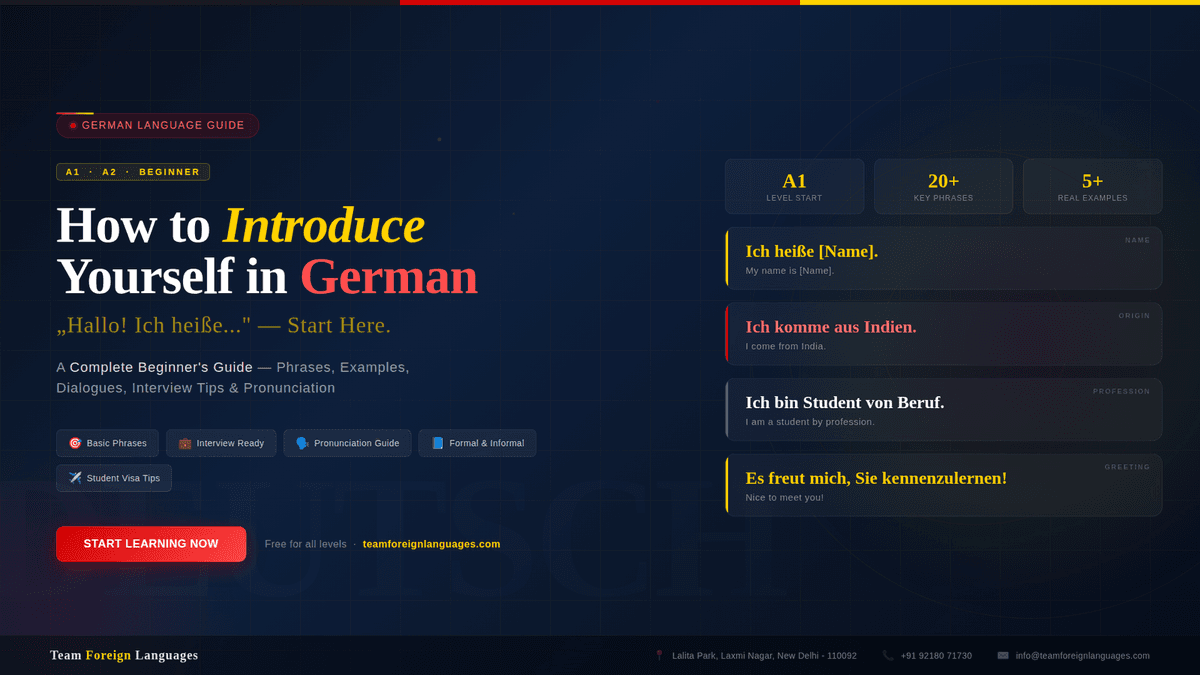
"Hallo, ich heiße [Name]. Ich komme aus [Country]. Ich bin [Age] Jahre alt. Ich spreche ein bisschen Deutsch."
(Hello, my name is [Name]. I come from [Country]. I am [Age] years old. I speak a little German.)
This 4-sentence structure covers name, origin, age, and language ability — everything needed for a simple A1-level introduction.
Want to know the cost of learning German? Check our German language course fees — https://www.teamforeignlanguages.com/blogs/german-language-course-fees
Ready to Speak German with Confidence?
Don't just read about it — speak it! Join our expert-led German language classes and go from "Hallo" to fluent faster than you think.
📍 Visit Us: 2/81-82, Ground Floor, Lalita Park, Laxmi Nagar, New Delhi - 110092 📞 Call Us: 91 92180 71730 📧 Email Us: info@teamforeignlanguages.com
[👉 Book Your Free Demo Class Today]
Basic Self Introduction in German (Beginner Sentences)
Here are the most essential sentences every beginner must learn:
- Hallo! / Guten Tag! Hello! / Good day! Pronunciation: Hah-loh / Goo-ten Tahk
- Ich heiße Anna. / Mein Name ist Anna. My name is Anna. Pronunciation: Ikh HY-seh Anna / Mine NAH-meh ist Anna
- Ich bin 25 Jahre alt. I am 25 years old. Pronunciation: Ikh bin FÜNF-und-TSVAN-tsikh YAH-reh alt
- Ich komme aus Indien / Deutschland / Amerika. I come from India / Germany / America. Pronunciation: Ikh KOM-eh owss…
- Ich wohne in Berlin / München / Wien. I live in Berlin / Munich / Vienna. Pronunciation: Ikh VOH-neh in…
- Ich bin Student / Lehrerin / Ingenieur. I am a student / teacher (female) / engineer. Pronunciation: Ikh bin Shtu-DENT / Lay-reh-RIN / In-zheh-NYUR
- Ich spreche Englisch und ein bisschen Deutsch. I speak English and a little German. Pronunciation: Ikh SHPREH-kheh ENG-lish oond ine BIS-khen Doytch
- Ich lerne seit drei Monaten Deutsch. I have been learning German for three months. Pronunciation: Ikh LEHR-neh zite dry MOH-nah-ten Doytch
- Es freut mich, Sie / dich kennenzulernen. Nice to meet you. (formal / informal) Pronunciation: Es froyt mikh, Zee / dikh KEN-en-tsoo-LEHR-nen
Explore options for students with after 12 qualifications in our German language course after 12 — https://www.teamforeignlanguages.com/blogs/german-language-course-after-12
German Self Introduction Example Paragraph
Below is a complete self-introduction paragraph suitable for class, travel, or a casual meeting.
German:
Hallo! Mein Name ist Rahul Sharma. Ich komme aus Indien, aber ich wohne jetzt in Berlin. Ich bin 27 Jahre alt. Ich bin Softwareentwickler von Beruf. Ich lerne seit sechs Monaten Deutsch. Ich spreche Englisch, Hindi und ein bisschen Deutsch. In meiner Freizeit lese ich gerne Bücher und höre Musik. Es freut mich, euch kennenzulernen!
English Translation:
Hello! My name is Rahul Sharma. I come from India, but I now live in Berlin. I am 27 years old. I am a software developer by profession. I have been learning German for six months. I speak English, Hindi, and a little German. In my free time, I like to read books and listen to music. Nice to meet you all!
Pronunciation Tips:
- Softwareentwickler = Soft-vah-reh-ENT-vik-ler
- Freizeit = FRY-tsyte
- kennenzulernen = KEN-en-tsoo-LEHR-nen
Want to learn how to greet people in German? Check our Greetings in German Language guide — https://www.teamforeignlanguages.com/blogs/greetings-in-german-language
Formal Self Introduction in German
Formal introductions are used in job interviews, office meetings, academic settings, and official events. The key difference is using "Sie" (formal you) instead of "du" (informal you), and using more professional vocabulary.
Example — Formal Introduction:
Guten Tag. Mein Name ist Priya Mehta. Ich komme aus Indien und wohne seit zwei Jahren in Deutschland. Ich habe einen Abschluss in Betriebswirtschaftslehre von der Universität Mumbai. Ich arbeite derzeit als Marketingmanagerin und verfüge über fünf Jahre Berufserfahrung. Ich spreche fließend Englisch und Deutsch auf dem Niveau B2. Ich freue mich sehr, Sie kennenzulernen.
English Translation:
Good day. My name is Priya Mehta. I come from India and have been living in Germany for two years. I have a degree in Business Administration from the University of Mumbai. I currently work as a Marketing Manager and have five years of professional experience. I speak English fluently and German at B2 level. I am very pleased to meet you.
Key Formal Phrases to Remember:
- Ich freue mich, Sie kennenzulernen — I am pleased to meet you (formal)
- Ich verfüge über... — I have / I possess (used for skills/experience)
- Ich bin derzeit tätig als... — I am currently working as...
- Ich habe einen Abschluss in... — I have a degree in...
- Meine Muttersprache ist... — My mother tongue is…
Boost your German skills quickly with our Best Ways to Learn German Language Fast guide — https://www.teamforeignlanguages.com/blogs/best-ways-to-learn-german-language-fast
Have Questions About Our German Course?
We're just one message away! Whether you're a complete beginner or looking to clear your Goethe A1/A2/B1 exam — our team is ready to guide you.
📞 Call/WhatsApp: 91 92180 71730 📧 Email: info@teamforeignlanguages.com 📍 Walk In: Lalita Park, Laxmi Nagar, New Delhi - 110092
Informal Self Introduction in German
Informal introductions work perfectly for college, making friends, youth hostels, language exchange partners, and casual social events. Use "du" and relaxed vocabulary.
Example — Informal Introduction:
Hey! Ich bin Jonas. Ich komme aus Hamburg, aber ich studiere jetzt in München. Ich bin 22 Jahre alt und studiere Informatik im dritten Semester. In meiner Freizeit spiele ich Gitarre und gehe gerne wandern. Ich lerne gerade Spanisch. Und du, wie heißt du?
English Translation:
Hey! I'm Jonas. I come from Hamburg but I'm now studying in Munich. I am 22 years old and studying Computer Science in the third semester. In my free time, I play guitar and like to go hiking. I'm currently learning Spanish. And you, what's your name?
Key Informal Phrases:
- Ich bin... — I am / I'm... (more casual than "Mein Name ist")
- Wie heißt du? — What's your name?
- Woher kommst du? — Where are you from?
- Was machst du so? — What do you do? (casual)
- Ich studiere... — I am studying…
Looking for structured German classes? See German courses in New Delhi A1 to C2 — https://www.teamforeignlanguages.com/blogs/german-courses-in-new-delhi-a1-to-c2
Self Introduction in German for Interview or Student Visa
For a job interview or student visa appointment, your German self-introduction needs to be structured, confident, and informative. Even if the interview is in English, opening with a German introduction makes an excellent impression.
Template for Interview / Visa Introduction:
Guten Tag. Mein Name ist [Full Name]. Ich komme aus [Country] und wohne seit [X] Monaten/Jahren in [City], Deutschland. Ich habe [Degree] in [Subject] an der [University Name] abgeschlossen. Ich bewerbe mich für die Stelle als [Job Title] / für den Studiengang [Course Name]. Ich spreche [Languages] und lerne aktiv Deutsch, um meine Kommunikationsfähigkeiten zu verbessern. Ich bin motiviert, fleißig und teamfähig. Ich freue mich auf dieses Gespräch.
English Translation:
Good day. My name is [Full Name]. I come from [Country] and have been living in [City], Germany for [X] months/years. I completed my [Degree] in [Subject] at [University Name]. I am applying for the position of [Job Title] / for the study program [Course Name]. I speak [Languages] and am actively learning German to improve my communication skills. I am motivated, hardworking, and a team player. I look forward to this conversation.
Power Words for Interviews:
- Ich bin teamfähig — I am a team player
- Ich bin belastbar — I work well under pressure
- Ich bin lernbereit — I am eager to learn
- Ich bringe Erfahrung mit in... — I bring experience in…
Discover job prospects with German skills in our Career Opportunities After Learning German in India guide — https://www.teamforeignlanguages.com/blogs/career-opportunities-after-learning-german-in-india
Visit Team Foreign Languages — New Delhi's Trusted Language Institute
Learning a foreign language is one of the best investments you can make in your career, studies, and life. Our expert trainers are here to make German easy, fun, and exam-ready for you.
📍 Our Address: 2/81-82, Ground Floor, Lalita Park, Laxmi Nagar, New Delhi - 110092
📞 Phone: 91 92180 71730 📧 Email: info@teamforeignlanguages.com
🕐 Mon – Sat | Morning & Evening Batches Available
Schedule a Free Counselling Session
German Self Introduction Dialogue
Here is a short, realistic dialogue between two people meeting for the first time — great for A1/A2 practice.
Anna: Hallo! Ich bin Anna. Wie heißt du? (Hello! I'm Anna. What's your name?)
Ben: Hallo Anna! Ich heiße Ben. Woher kommst du? (Hello Anna! My name is Ben. Where are you from?)
Anna: Ich komme aus Österreich, aus Wien. Und du? (I come from Austria, from Vienna. And you?)
Ben: Ich komme aus Kanada, aber ich wohne seit einem Jahr in Berlin. (I come from Canada, but I've been living in Berlin for a year.)
Anna: Interessant! Was machst du hier? (Interesting! What do you do here?)
Ben: Ich studiere Deutsch an der Freien Universität. Und du? (I am studying German at the Free University. And you?)
Anna: Ich arbeite als Ärztin in einem Krankenhaus hier. Es freut mich, dich kennenzulernen! (I work as a doctor in a hospital here. Nice to meet you!)
Ben: Mich auch! Bis bald! (Me too! See you soon!)
Find the best tools to improve your German in our Top Resources for Learning German Language guide — https://www.teamforeignlanguages.com/blogs/top-resources-for-learning-german-language
Common Mistakes While Introducing Yourself in German
Even beginners can avoid these errors with a little awareness:
| Wrong Sentence | Correct Sentence | Explanation |
| Ich bin heiße Tom. | Ich heiße Tom. | Don't mix "bin" and "heiße" |
| Ich komme von Indien. | Ich komme aus Indien. | Use "aus" not "von" for countries |
| Ich habe 25 Jahre. | Ich bin 25 Jahre alt. | German uses "sein" (to be) for age |
| Ich lerne Deutsch seit drei Monat. | Ich lerne Deutsch seit drei Monaten. | "Monaten" is the dative plural |
| Mein Name bin Rahul. | Mein Name ist Rahul. | "Name" takes "ist," not "bin" |
| Ich spreche ein bisschen Deutsches. | Ich spreche ein bisschen Deutsch. | No adjective ending after "bisschen" |
| Ich arbeite als ein Lehrer. | Ich arbeite als Lehrer. | No article after "als" for professions |
Important German Words Used in Self Introduction
Here's the refined, visually engaging version of the vocabulary table — broken into themed groups with added context:
Find nearby German classes with our German language classes near me guide — https://www.teamforeignlanguages.com/blogs/german-language-classes-near-me
Essential German Words for Self Introduction
Learning isolated words is hard. Learning them in context is easy. That's why this vocabulary list is organized by category, so your brain absorbs them faster and retains them longer.
Greetings — Start Strong
| German Word | English Meaning | When to Use |
| Hallo | Hello | Anytime, anywhere |
| Guten Morgen | Good morning | Before noon |
| Guten Tag | Good day | Daytime, formal |
| Guten Abend | Good evening | After 6 PM |
| Hey / Hi | Hey / Hi | Casual, with friends |
🪪 Introducing Your Name
| German Word | English Meaning | Pro Tip |
| Mein Name ist... | My name is... | Slightly formal |
| Ich heiße... | I am called... | Most common, natural |
| Man nennt mich... | People call me... | Used for nicknames |
Quick Tip: "Ich heiße" flows more naturally in speech. "Mein Name ist" sounds more polished in interviews or formal settings.
Check our latest breakdown on German language exam fees in India — https://www.teamforeignlanguages.com/blogs/german-language-exam-fees-in-india
Talking About Where You're From
| German Word | English Meaning | Example |
| Ich komme aus... | I come from... | Ich komme aus Indien |
| Ich wohne in... | I live in... | Ich wohne in Berlin |
| Ich bin gebürtig aus... | I was born in... | Ich bin gebürtig aus Mumbai |
| Ich lebe seit... in... | I have lived in... since... | Ich lebe seit 2 Jahren in Deutschland |
Common Mistake: Never say "Ich komme von Indien." Always use "aus" for countries and cities.
Age & Personal Details
| German Word | English Meaning | Example |
| Ich bin ... Jahre alt | I am ... years old | Ich bin 25 Jahre alt |
| Ich bin geboren am... | I was born on... | Ich bin am 5. März geboren |
| Meine Muttersprache ist... | My mother tongue is... | Meine Muttersprache ist Hindi |
| Ich spreche... | I speak... | Ich spreche Englisch und Deutsch |
Profession & Study
| German Word | English Meaning | Example |
| Ich arbeite als... | I work as... | Ich arbeite als Ingenieur |
| Ich bin ... von Beruf | I am a ... by profession | Ich bin Lehrerin von Beruf |
| Ich studiere... | I am studying... | Ich studiere Medizin |
| Ich bin im ... Semester | I am in the ... semester | Ich bin im dritten Semester |
| Ich bin selbstständig | I am self-employed | Great for freelancers |
Grammar Note: In German, you never use an article after "als" for professions. Say "Ich arbeite als Lehrer" NOT “als ein Lehrer.”
Learn about different proficiency levels in our German language course levels guide — https://www.teamforeignlanguages.com/blogs/german-language-course-levels
Hobbies & Interests
| German Word | English Meaning | Example |
| In meiner Freizeit... | In my free time... | In meiner Freizeit lese ich |
| Ich interessiere mich für... | I am interested in... | Ich interessiere mich für Musik |
| Mein Hobby ist... | My hobby is... | Mein Hobby ist Kochen |
| Ich reise gerne | I love to travel | Very common phrase |
| Ich lerne gerade... | I am currently learning... | Ich lerne gerade Deutsch |
Wrapping Up — Polite Closings
| German Word | English Meaning | Formality |
| Es freut mich | Nice to meet you | Neutral |
| Es freut mich sehr | Very pleased to meet you | Formal |
| Schön, dich kennenzulernen | Nice to meet you | Informal |
| Auf Wiedersehen | Goodbye | Formal |
| Tschüss / Tschau | Bye / Ciao | Informal |
| Bis bald! | See you soon! | Friendly |
Asking Questions Back — Keep the Conversation Going
Find the perfect online program in our Best Online German Language Course guide — https://www.teamforeignlanguages.com/blogs/best-online-german-language-course
| German Question | English Meaning | Formality |
| Wie heißt du? | What's your name? | Informal |
| Wie heißen Sie? | What is your name? | Formal |
| Woher kommst du? | Where are you from? | Informal |
| Woher kommen Sie? | Where are you from? | Formal |
| Was machst du? | What do you do? | Informal |
| Was machen Sie beruflich? | What do you do professionally? | Formal |
Golden Rule: Use "du" with friends, classmates, and people your age. Switch to "Sie" with strangers, seniors, professors, and in professional settings. Getting this right instantly makes you sound more fluent.
Quick Memory Cheat Sheet
| Category | Key Word to Remember |
| Name | Ich heiße / Mein Name ist |
| Origin | Ich komme aus |
| Home | Ich wohne in |
| Age | Ich bin ... Jahre alt |
| Job | Ich arbeite als / von Beruf |
| Study | Ich studiere |
| Language | Ich spreche / Meine Muttersprache |
| Hobby | In meiner Freizeit |
| Meeting | Es freut mich |
| Goodbye | Tschüss / Auf Wiedersehen |
This grouped, example-rich format turns a plain word list into a mini phrasebook you can actually use in real conversations from day one.
Learn essential vocabulary with our Basic German Words for Beginners guide — https://www.teamforeignlanguages.com/blogs/basic-german-words-for-beginners
New German Batch Starting Soon — Don't Miss Out!
Seats fill up fast. If you've been thinking about learning German for travel, studies, job abroad, or just personal growth — now is the time.
A1 | A2 | B1 | B2 | C1 Levels Available 🎯 Goethe & TestDaF Exam Preparation 🎯 Spoken Written Grammar — All Covered
📍 2/81-82, Ground Floor, Lalita Park, Laxmi Nagar, New Delhi - 110092 📞 91 92180 71730 📧 info@teamforeignlanguages.com
[🚀 Reserve Your Seat Before It's Gone!]
FAQs: How to Introduce Yourself in German
Q1: How do I introduce myself in German A1? At A1 level, keep it simple. Say: "Hallo, ich heiße [Name]. Ich komme aus [Country]. Ich bin [Age] Jahre alt. Ich lerne Deutsch." This covers the four basics: name, origin, age, and language learning — which is all you need at A1.
Q2: What is a simple self introduction in German? A simple German self introduction is: "Mein Name ist [Name]. Ich komme aus [Country] und wohne in [City]. Ich bin [profession/student]." This three-sentence format works in almost any beginner situation.
Q3: How do you say "My name is" in German? There are two ways to say "my name is" in German. You can say "Ich heiße [Name]" (literally "I am called") or "Mein Name ist [Name]" (literally "My name is"). Both are correct and widely used.
Q4: How do you say "I am from" in German? To say "I am from" in German, use "Ich komme aus..." For example, "Ich komme aus Indien" means "I am from India." Always use "aus" for countries and cities, never "von."
Q5: What is a German self introduction for a job interview? For a job interview, begin formally: "Guten Tag, mein Name ist [Name]. Ich habe [Degree] in [Field] und verfüge über [X] Jahre Berufserfahrung." Always use "Sie" (formal you), speak clearly, and include your qualifications, experience, and motivation.
Q6: How do you introduce yourself in German for a student visa? For a student visa interview, mention your name, country, university, course of study, and German language level. Example: "Ich heiße [Name], komme aus [Country] und möchte [Subject] an der [University] studieren. Ich lerne aktiv Deutsch."
Q7: What is the difference between "Ich heiße" and "Mein Name ist"? Both mean "My name is," but "Ich heiße" is slightly more conversational and direct, while "Mein Name ist" sounds a touch more formal. In everyday speech and beginner learning, both are completely interchangeable.
Conclusion
Knowing how to introduce yourself in German is the foundation of every German conversation you will ever have. From casual meetups to formal job interviews and student visa appointments, a clear, confident introduction tells people who you are, where you come from, and what you are doing — all in just a few sentences.
Start with the basics: your name, country, age, and profession. Then add hobbies, language skills, and goals as your German improves. Practice the example paragraph out loud every day. Record yourself. Repeat the dialogue with a language partner. The more you say it, the more natural it becomes.
Remember: every native German speaker appreciates the effort you make to speak their language — even imperfectly. Your first "Hallo, ich heiße..." is already a victory. Keep going.
Viel Erfolg! — Best of luck!