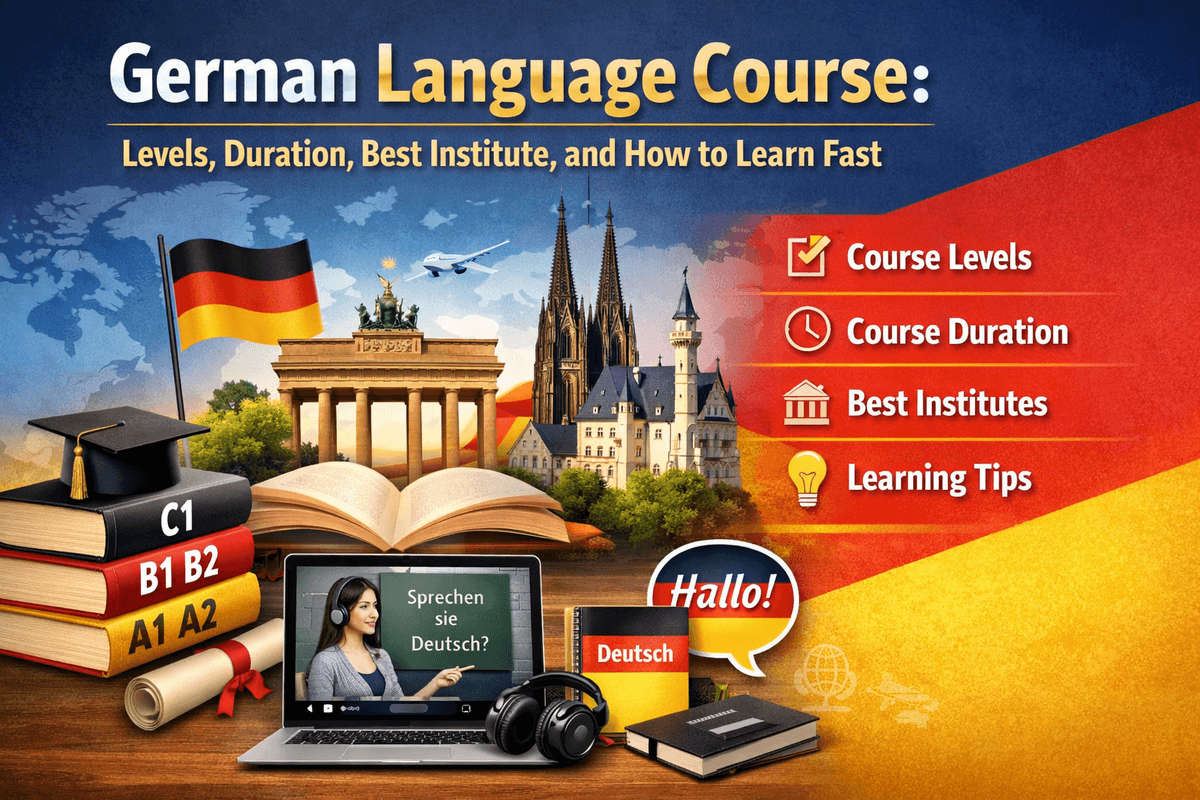
German Language Course: Levels, Duration, Best Institute, and How to Learn Fast
Published: 2026-02-06 07:10:36
If you search for german language course on Google, you will notice dozens of questions people repeatedly ask. Questions like Which German language course is best?, What is A1 to C2?, Can I learn German in 3 months?, Is B2 German fluent? and How to learn German in 1 month? dominate the search results.
These are not random doubts. These are the exact pain points of students, job seekers, travelers, and professionals who want to learn German for career, study, or migration.
This guide answers all those questions in detail and helps you understand:
- Which German level you actually need
- How long it takes to learn German
- Whether you can learn German in 30/60/90 days
- Which certification is best (Goethe vs others)
- Where to learn German in Delhi from experienced trainers
Explore German courses: https://www.teamforeignlanguages.com/courses/german
Which German Language Course Is Best?
The “best” German course isn’t one-size-fits-all it depends on what you want to achieve with the language. German proficiency is structured under the CEFR (Common European Framework of Reference), which divides learning into clear levels from A1 to C2. Choosing the right level from the start saves time, money, and confusion.
Here’s a quick guide to match your goal with the right level:
| Your Goal | Recommended Level |
| Daily conversation, travel, basics | A1 – A2 |
| Study in Germany | B1 – B2 |
| Job in Germany / MNC roles | B2 – C1 |
| Translation, teaching, advanced mastery | C1 – C2 |
A quality German course should build all four skills speaking, listening, reading, and writing through a structured, level-based curriculum. This ensures steady progress and prepares you for recognized certifications.
Be cautious of “shortcut” programs that promise instant fluency without proper levels or exam readiness. Real progress in German comes from systematic learning aligned with CEFR, guided practice, and consistent speaking exposure.
Find where to learn German in Delhi: https://www.teamforeignlanguages.com/blogs/where-to-learn-german-language-in-delhi
What Are A1, A2, B1, B2, C1, C2 in German?
German learning follows the CEFR (Common European Framework of Reference), an international standard that clearly defines what you can understand, speak, read, and write at each stage. These six levels A1 to C2 act like milestones on your journey from absolute beginner to near-native mastery.
Here’s how each level transforms your ability:
- A1 (Beginner): You learn essential words, greetings, numbers, and how to introduce yourself. You can form very simple sentences and handle basic everyday situations.
- A2 (Elementary): You start having short conversations about daily life family, shopping, routines, and travel. Your vocabulary and sentence structure grow steadily.
- B1 (Intermediate): You become an independent speaker. You can discuss experiences, plans, and opinions with better grammar control and confidence.
- B2 (Upper Intermediate): You communicate comfortably in professional and academic contexts. You understand news, participate in discussions, and express ideas clearly.
- C1 (Advanced): You speak fluently on complex topics, understand detailed texts, and use German effectively in study or work environments.
- C2 (Mastery): You achieve near-native proficiency. You can understand almost everything you read or hear and express yourself precisely and naturally.
Each level is not just a certificate it’s a real upgrade in how confidently you can live, study, and work in German.
What Does Language Level A1, A2, B1, B2, C1, C2 Mean?
These levels aren’t just labels on a certificate they describe what you can actually do in German as you progress. With every step from A1 to C2, your ability to understand, speak, read, and write grows in real, practical ways you can use in daily life, studies, and work.
As you move up the levels, you become better at:
- Understanding spoken German in conversations, audio, and videos
- Reading newspapers, emails, and articles with ease
- Speaking clearly and confidently in different situations
- Writing both informal messages and formal documents
Here’s how that looks in real life:
- At A1, you can introduce yourself, ask simple questions, and manage basic interactions.
- At B1, you can attend interviews, share opinions, and handle everyday discussions independently.
- At B2, you are comfortable working in a German-speaking company and participating in professional conversations.
- At C1, you can study at a German university, understand lectures, and express complex ideas fluently.
Each level is a practical upgrade that brings you closer to living, studying, or working comfortably in a German-speaking environment.
Learn more about the German language school: https://www.teamforeignlanguages.com/blogs/german-language-school
Is C2 German Fluent?
Absolutely. C2 is the highest level of German proficiency and is widely regarded as near-native fluency. At this stage, German no longer feels like a foreign language you understand it, think in it, and use it naturally in any situation.
At the C2 level, you can:
- Understand virtually everything you read or hear, even fast, complex speech
- Express ideas spontaneously, precisely, and without searching for words
- Use idioms, advanced vocabulary, and complex grammar with ease
- Adapt your language style for formal, academic, or casual settings effortlessly
However, it’s important to know that you don’t always need C2 to achieve your goals. For most professional careers, higher studies, or migration purposes, B2 or C1 is more than sufficient and widely accepted.
C2 is mastery but for many learners, B2/C1 already unlocks real-world opportunities.
Learn German language course in Delhi: https://www.teamforeignlanguages.com/blogs/learn-german-language-course-in-delhi
Is B2 German Fluent?
Yes B2 is considered professionally fluent. At this level, you’re no longer forming basic sentences; you’re communicating ideas clearly, confidently, and appropriately in real-world settings.
With B2 German, you can:
- Work effectively in German-speaking companies and MNCs
- Understand and participate in university lectures and discussions
- Meet common visa and job language requirements for Germany
- Handle interviews, presentations, and workplace conversations with confidence
This is exactly why B2 is the most in-demand level among learners in India aiming for jobs, study, or migration.
Is C1 or B2 Fluent?
Both are strong levels—but they serve slightly different goals:
- B2 = Professional fluency (ideal for jobs and migration)
- C1 = Academic and advanced fluency (preferred for higher studies and research)
If your goal is a job or relocation → B2 is usually enough.
If your goal is higher education in Germany → C1 is preferred.
Think of it this way: B2 helps you work comfortably in German, while C1 helps you study and analyze complex subjects with ease.
Check the latest ECL exam dates: https://www.teamforeignlanguages.com/blogs/ecl-exam-dates
Which Course Is Best to Learn German? Goethe or Others?
This is a very common question: Should I learn German at Goethe, or choose another institute?
Here’s the honest answer: Goethe is a certification body, not a guarantee of great classroom learning. The certificate is valuable but your real progress depends on how and where you’re taught.
What truly shapes your German skills is the quality of training, practice, and guidance you receive day to day.
A strong German institute should offer:
- Certified, experienced trainers who explain grammar simply and clearly
- Dedicated speaking practice so you don’t just learn German—you actually speak it
- Focused exam preparation aligned with Goethe patterns and standards
- Small batch sizes for personal attention and doubt clearing
- Practical sessions with role-plays, listening drills, and real-life conversations
In short, the best course is one that prepares you both for the exam and for real communication. The certificate matters but the learning experience matters even more.
Understand German language levels: https://www.teamforeignlanguages.com/blogs/german-language-levels
Can I Learn German in 3 Months?
Yes with intensive training and daily practice, reaching A2 (and in many cases B1) within 3 months is absolutely realistic.
In this time, you can:
- Build a strong, usable vocabulary for everyday situations
- Master the core grammar foundations that power sentence formation
- Start speaking basic German with confidence, not hesitation
- Prepare effectively for A1/A2 exams, and even step into B1 topics
If you attend regular classes, revise consistently, and practice speaking every day, B1 becomes an achievable milestone in 90 days.
See German language exams 2026: https://www.teamforeignlanguages.com/blogs/german-language-exams-2026
What Is the Shortest Time to Learn German?
Your progress depends on consistency, but here’s a practical fast-track timeline many learners follow:
| Duration | Possible Level |
| 1 month | A1 basics |
| 3 months | A2 / B1 |
| 6 months | B2 |
| 9–12 months | C1 |
The key is intensity guidance. With the right structure and routine, you can move through levels faster than you think without compromising understanding.
Can You Reach B1 German in 3 Months?
Yes—you can reach B1 level in 3 months if your learning is focused, structured, and consistent.
This becomes possible when you:
- Attend daily classes with guided instruction
- Practice speaking German every single day (not just reading or writing)
- Learn 30–40 new words daily and revise them actively
- Follow a clear grammar roadmap instead of random topics
An intensive classroom program, regular feedback, and speaking drills can accelerate your progress far beyond casual self-study.
Learn how to learn the German language: https://www.teamforeignlanguages.com/blogs/how-to-learn-german-language
How to Learn German in 90 Days (Practical Plan)
A simple, effective 90-day roadmap:
- Month 1: Build A1 foundation — pronunciation, basic grammar, essential vocabulary
- Month 2: Move to A2 — daily conversations, sentence building, listening practice
- Month 3: Step into B1 — complex sentences, opinions, mock tests, and real speaking practice
Stay consistent, revise daily, and prioritize speaking. Discipline over motivation is what gets you to B1 in 90 days.
Can I Learn German in 30 Days?
Yes you can complete A1 level in 30 days with focused, intensive learning. The key is a tight routine and daily practice that covers all essentials.
In one month, you can confidently learn:
- German alphabets and correct pronunciation
- Common greetings and daily-use conversations
- Basic sentence formation for real-life situations
By the end of 30 days, you won’t just recognize words—you’ll be able to use simple German actively.
Check German language course duration: https://www.teamforeignlanguages.com/blogs/german-language-course-duration
How to Learn German in 1 Month (Daily Routine)
A smart daily schedule makes all the difference:
- 2 hours class for guided learning and grammar clarity
- 1 hour vocabulary building and revision
- 30 minutes listening to train your ear for German sounds
- 30 minutes speaking to build confidence and fluency
Follow this consistently, and you’ll build a solid A1 foundation in just one month.
How Much German Can You Learn in 1 Month?
A month of consistent effort can take you surprisingly far. With daily study and speaking practice, you’ll be able to:
- Speak basic, meaningful sentences for everyday situations
- Introduce yourself and share simple personal details
- Ask and answer common questions confidently
- Understand slow, clear German speech in conversations and audio clips
You won’t be fluent yet—but you’ll have a usable foundation you can build on quickly.
Explore the German language course online: https://www.teamforeignlanguages.com/blogs/german-language-course-online
What Is 77777 in German?
Learning numbers is an essential (and fun) part of A1. It trains pronunciation, listening, and sentence rhythm.
77,777 in German is:
Siebenundsiebzigtausendsiebenhundertsiebenundsiebzig
Long? Yes. Logical? Also yes. German numbers follow a pattern—once you learn it, even big numbers become easy to read and say.
What Is the #1 Hardest Language?
German often gets labeled “difficult,” but it’s not the hardest language to learn. In fact, many learners find it manageable because:
- The grammar is logical and rule-based
- Pronunciation is consistent (words sound the way they’re written)
- Sentence structures follow clear, repeatable patterns
With the right guidance and practice, German feels less intimidating and far more systematic than its reputation suggests.
Discover the online German language course: https://www.teamforeignlanguages.com/blogs/online-german-language-course
Who Can Speak 42 Languages Fluently?
You might see this question pop up online and wonder if learning many languages is the real goal. It’s fascinating, sure but for most learners, it’s not practical or necessary.
What truly matters is mastering one language to a useful, certified level.
Instead of chasing dozens of languages, focus on achieving a strong German certification that opens real doors for jobs, studies, and migration. One well-learned language at B2 or C1 can change your career far more than knowing bits and pieces of many.
Depth beats quantity especially with German.
See details on the German language course: https://www.teamforeignlanguages.com/blogs/german-language-course
Where to Learn the Best German Language Course in Delhi?
If you’re searching for the best German language institute in Delhi, don’t just look at ads look for the fundamentals that actually shape results:
- Experienced trainers who simplify grammar and correct your speaking in real time
- A structured CEFR curriculum (A1 to C2) so your progress is clear and measurable
- Dedicated exam preparation aligned with Goethe patterns
- Strong speaking practice built into every class
- Affordable fees with real value for learning
- Small batches for personal attention and faster improvement
TILS – School of Foreign Languages (Highly Recommended)
TILS stands out for turning beginners into confident German speakers through practical, level-based training.
TILS is known for:
- Expert German trainers with years of teaching experience
- Focused Goethe exam preparation at every level
- Intensive speaking sessions so you learn to communicate, not just memorize
- Fast-track batches for students on tight timelines
- Personal attention and regular feedback
- A high success rate from A1 to C1 levels
Thousands of learners have successfully completed their German journey here from absolute beginners to advanced speakers making TILS a trusted choice for serious German learners in Delhi.
Learn about the German language: https://www.teamforeignlanguages.com/blogs/german-language
Why Choose TILS for German Language Course?
Choosing the right institute can make the difference between studying German and actually speaking German. TILS focuses on practical progress, not just textbook completion.
Here’s what sets TILS apart:
- CEFR-based curriculum (A1 to C2): Clear, level-wise learning aligned with international standards
- Practical training: Real conversations, role-plays, and listening drills built into classes
- Interview preparation: Special focus on job interviews and professional communication in German
- Visa language preparation: Targeted training for students and professionals planning Germany migration
- Flexible batch timings: Morning, afternoon, and evening options for students and working professionals
- Affordable fees: Quality training that stays accessible without compromising learning outcomes
At TILS, the goal isn’t just to help you pass an exam—it’s to help you use German confidently in real-life situations.
Visit TILS – School of Foreign Languages
Visit Us
2/81-82, Ground Floor, Lalita Park, Laxmi Nagar, New Delhi - 110092
Call Us
91 9218071730
Email Us
info@teamforeignlanguages.com
FAQs – German Language Course
How many months does it take to learn German?
6 months for B2, 3 months for A2/B1.
Is German useful for jobs?
Yes, German opens jobs in MNCs, embassies, and abroad.
Is German harder than English?
No. German grammar is logical and structured.
Which level is required for Germany visa?
Usually B1 or B2.
Can beginners learn German easily?
Yes, with proper guidance and practice.
Do I need coaching for German?
Self-study is slow. Coaching accelerates learning.
Final Thoughts
All the questions people ask on Google about German levels, time, fluency, certification have one simple answer:
Learn German from a professional institute with structured training.
If you are serious about learning German for career, study, or migration, TILS – School of Foreign Languages in Laxmi Nagar, Delhi is one of the best choices to start your journey from A1 to C1 confidently.
German is not hard.
Wrong guidance is.
Start with the right institute, and fluency becomes achievable.